
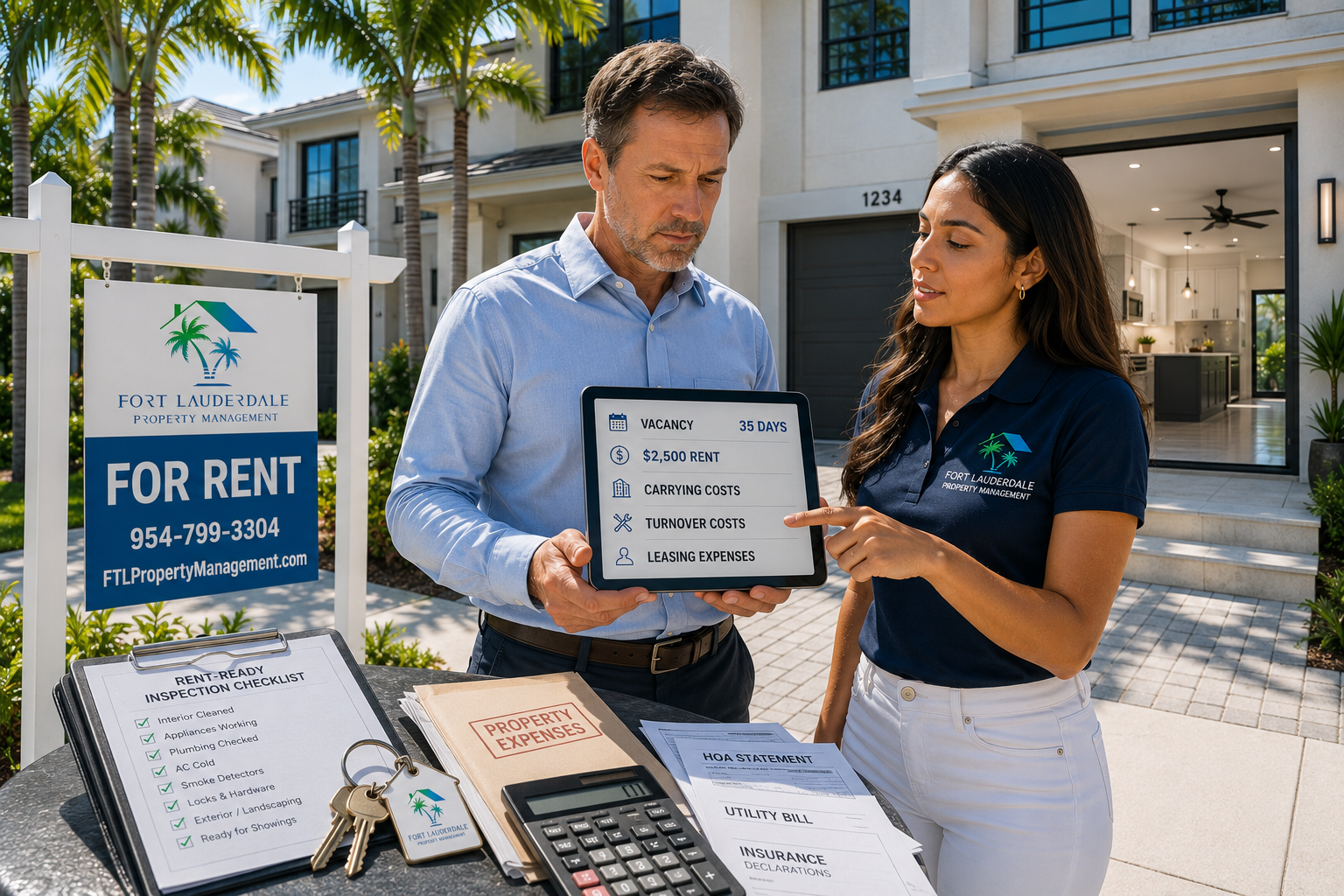
The Hidden Cost of Vacancy: Why Every Empty Day Costs More Than You Think
I was having a beer (don’t judge) with a rental owner whose duplex in Victoria Park had a unit that had been vacant for about five weeks between tenants. When we started talking about what the vacancy had actually cost him, he basically looked at it as one month's lost rent.
I understood why he looked at it that way. Lost rent is the number everyone sees first.
But it isn't the number that tells you what the vacancy actually costs.
During those five weeks, the mortgage didn't stop. The HOA didn't stop. Insurance didn't stop. The property still needed utilities, cleaning, repairs and marketing. And every additional day the property sat empty increased the amount of revenue the property would have to make up later.
For a Broward County rental owner, an empty property can be especially frustrating because the clock doesn't stop just because the property isn't producing income.
A vacant property can lose the rent it would have produced while the owner continues paying the mortgage, taxes, insurance, HOA dues and utilities. Then come the costs of preparing the property, marketing it and finding the next tenant.
That's why I think landlords should stop thinking about vacancy as "lost rent" and start thinking about it as a daily operating cost.
Key Takeaways For Fort Lauderdale Rental Property Owners:
Vacancy costs more than lost rent. Mortgage payments, taxes, insurance, HOA dues, utilities, turnover work, marketing and the owner's time can continue accumulating while a property is empty.
Every vacant day has a real economic cost. Looking at vacancy as a daily operating expense makes it easier to evaluate whether waiting for a higher rent is actually worth the additional time on the market.
A slow rental isn't always a pricing problem. Before lowering the rent, evaluate the property's price, presentation, condition and the amount of qualified demand it is generating.
Broward County rentals can have different lease-up timelines. Condo buildings may have application, approval and move-in requirements that affect the timeline, while single-family and multifamily properties can have their own turnover considerations.
The best way to reduce vacancy is to manage the transition between tenants proactively. Start the leasing process early, coordinate turnover efficiently, price the property based on current competition and respond quickly when the market provides feedback.
The Bills That Don't Pause Just Because Nobody's Living There
For Fort Lauderdale and Broward County rental owners, the cost of vacancy can also depend on what type of property you're dealing with. A vacant single-family home, a condo in a managed building, and a small multifamily property can all have very different lease-up timelines and turnover requirements.
A condo, for example, may involve building-specific rental restrictions, application requirements, showing procedures or move-in scheduling that can add time to the process even after the unit itself is ready. A single-family home may have fewer building restrictions, but landscaping, exterior maintenance, cleaning and repairs can become part of the turnover process.
The important point is that the vacancy clock doesn't start when you decide you're ready to rent the property. It starts when the property stops producing rental income. The more steps between one tenant leaving and the next tenant moving in, the more expensive every additional day can become.
Your fixed costs don't take a break during a vacancy. The mortgage still comes due. Property taxes and insurance keep accruing. If there's an HOA, that payment doesn't care whether anyone's actually living in the unit.
And you're usually still paying for basic utilities, since you need power and water running for showings, cleaning, and general upkeep while the unit sits empty.
Add all of that up and the daily cost of an empty unit becomes a lot clearer than just dividing the rent by thirty. A property with a decent-sized mortgage, taxes, insurance, and HOA fees can easily be burning through triple digits every single day it's unoccupied, even before you count the rent you're not collecting.
The Turnover Costs That Show Up Whether You Expect Them or Not
Between tenants, there's almost always some amount of work that needs to happen before the property is ready to show, let alone ready for a new tenant to move in.
This is one area where the difference between having a property "vacant" and having a property "ready to lease" matters. In South Florida, a property may need cleaning, touch-up paint, minor repairs, landscaping or other make-ready work before it is truly marketable. With a condo, there may also be building requirements or scheduling considerations that have to be handled before the next tenant can take possession.
Every day spent waiting for a vendor, completing a repair or coordinating the next step is another day the property isn't producing rent. That's why an efficient turnover isn't simply about getting the work done correctly. It's about getting the work done correctly without allowing unnecessary days to accumulate between tenancies.
Cleaning, touch-up paint, minor repairs, and sometimes bigger fixes like flooring or appliance replacement all tend to cluster right around turnover, because that's the one window when the unit is actually empty enough to get the work done.
In South Florida, turnover also means paying attention to the condition of the property beyond the four walls. Depending on the property, landscaping, exterior presentation, HVAC performance and general curb appeal can all affect how the rental shows to prospective tenants.
These costs add up faster than people expect. Multiple property management industry association sources put the typical all-in cost of a single tenant turnover, once you include vacancy loss, cleaning, repairs, and re-leasing expenses, somewhere in the range of a couple thousand dollars on the low end and up to several thousand on the higher end, depending on the market and how much work the unit actually needs.
And that's assuming things go smoothly. If a turnover involves significant repairs, an unusually long vacancy, or an eviction, the total cost can climb substantially.
Marketing and Leasing Costs
Getting a unit back in front of qualified renters costs money too, and it's easy to overlook because the individual line items feel small.
Listing fees, professional photos, and sometimes a leasing commission if you're using an agent or property manager to help fill the unit all add up over the course of a vacancy.
For condo owners in Broward County, the leasing process can also involve another layer of coordination that doesn't exist with every single-family rental. The property may be ready, the marketing may be working and a qualified tenant may be interested, but the building's application and approval process can still affect the timeline. For an owner, that means the property's "vacancy period" can sometimes include time that has nothing to do with whether the unit itself is marketable—it can also include time spent coordinating the building's requirements before the next tenant can actually move in.
That is one reason I don't think landlords should measure leasing performance solely by how quickly a tenant signs a lease. The real goal is to minimize the time between the previous tenancy ending and the next tenancy producing income, while still following the property's building requirements and properly screening the next tenant.
None of these expenses are enormous on their own, but they're real dollars that a landlord focused only on the rent number tends to forget when they're estimating what an empty unit is actually costing them.
Filling a vacancy quickly doesn't mean skipping the screening process. The goal is to reduce unnecessary vacancy while still following a consistent, legally compliant screening process.
How to screen tenants without violating Fair Housing laws
The Part That's Easy to Miss: Time and Risk
There's a cost to vacancy that doesn't show up on a spreadsheet as easily, and that's the time you or your property manager spend handling showings, screening applicants, and coordinating the turnover itself.
If you're self-managing, every hour spent on that process is an hour you're not spending elsewhere, and it's worth putting an actual dollar value on your own time rather than treating it as free.
There's also a market timing risk that's easy to underestimate. A rental doesn't exist in a vacuum. The tenant pool you're competing for is looking at other properties at the same time, and those alternatives change constantly.
If your property sits for several weeks, you're not necessarily competing against the same inventory you were competing against on day one. New listings come on the market, other owners adjust their asking rents and renters who were available when you first listed may have already signed elsewhere.
That's why I pay attention to what the market is telling us during the leasing process rather than treating the original asking price as something that can't be questioned. The longer a property sits without meaningful activity, the more important that feedback becomes.
The longer a unit sits empty, the more pressure builds to drop the rent just to get someone in the door, which means a slow vacancy doesn't just cost you the days it takes to fill, it can also cost you the rent difference for the entire length of the new lease if you end up settling for a lower number than you originally wanted.
For owners who self-manage, those hours have a real economic cost. I explore that broader issue in The Hidden Cost of Self-Managing a Rental Property .
Why Pricing It Right the First Time Matters So Much
This is where a lot of the real damage happens, and it's almost entirely avoidable. Units priced accurately for the market tend to lease noticeably faster than units priced even slightly above where they should be, because renters comparison shop and a unit that's priced a bit high just sits there while better-priced options down the street get snapped up.
Holding out for an extra fifty or hundred dollars a month can end up costing far more than that if it means an extra two or three weeks of vacancy while you wait for the right renter to come along.
The other mistake I see owners make is looking at the asking rent in isolation. When I evaluate a rental, I'm not just asking, "Can we get another $100 a month?" I'm also asking, "What is the property competing against right now, and how much time are we willing to spend finding the tenant who will pay it?"
Even within Fort Lauderdale, rental demand and competition can vary significantly by neighborhood, property type and price point. A rental near Victoria Park, Flagler Village or the beach can be competing against a very different set of alternatives than a property farther west in Broward County.
That means looking at the competing rentals, the property's condition, the quality of the photography and marketing, showing activity and the feedback we're getting from prospective tenants. If a property is generating very little interest, the answer isn't always to immediately lower the rent. Sometimes the price is wrong. Sometimes the property isn't being presented well. And sometimes the market is telling you that the property simply isn't as competitive as the owner thought it was.
In Broward County, that comparison can be especially important because renters have a lot of options across different property types and neighborhoods. A prospective tenant looking at a Fort Lauderdale condo may also be comparing it against a townhouse, apartment or single-family rental a short drive away. That means a property doesn't compete only against rentals that look exactly like it.
The right question isn't simply whether the asking rent is reasonable in isolation. It's whether the property represents a compelling value compared with the alternatives a renter can realistically choose from right now.
The important thing is to identify the problem early, because waiting three weeks to make a decision can be far more expensive than making the right adjustment after the first few days of market feedback.
The math almost always favors pricing accurately and filling the unit quickly over holding out for a higher number and eating weeks of vacancy while you wait. A slightly lower rent collected starting today usually beats a slightly higher rent that doesn't start for another month.
Biggest Mistake I See Landlords Make When Pricing a Rental
If a Property Isn't Leasing, Find Out Why
When a rental isn't leasing, the answer isn't always to lower the rent. Before making a pricing decision, I would look at four things: price, presentation, property and demand.
Price: Is the asking rent competitive with the properties a renter is actually choosing between?
Presentation: Are the photos, description, showing experience and overall marketing making the property look as good as the alternatives?
Property: Is there something about the condition, layout, location or features that is making the property less attractive than competing rentals?
Demand: Are qualified renters actually seeing the property and asking to see it, or is the listing failing to generate meaningful interest?
Those four questions help separate a pricing problem from a marketing problem or a property problem. That's important because lowering the rent won't fix a property that is poorly marketed, difficult to show or being held back by an issue that has nothing to do with price.
How Long Should It Take to Rent a Property in Fort Lauderdale
What This Actually Means for Your Return
Vacancy doesn't just hurt your cash flow in the short term. It affects how the property performs as an investment overall.
If you're renting a property at eighteen hundred dollars a month and it sits empty for two months out of the year, that alone represents a meaningful chunk of your annual rental income gone, before you even add in the turnover and marketing costs layered on top of it.
For example, If you're renting a property at $1,800 per month and it sits empty for two months out of the year, you've already lost $3,600 in scheduled rental income before adding the turnover, marketing and other costs associated with finding the next tenant.
That is why vacancy deserves to be viewed as an investment-performance issue, not just a temporary cash-flow problem. A property that consistently experiences longer vacancies has less income available to cover its expenses and produce a return for the owner.
If you hold your properties long-term, there's also a value dimension to this. For income-producing properties, rental income is an important part of how investors evaluate the property's performance and, depending on the property and circumstances, its value. A pattern of longer vacancies doesn't just cost you in the moment, it can actually work against the property's value if you ever go to sell or refinance, since buyers and lenders both look at occupancy history as a signal of how well the property performs.
How to Think About the True Cost of Vacancy
I find it helpful to break vacancy into four categories rather than looking at the rent alone:
Lost rental income: the rent the property would have produced if it were occupied.
Continuing property expenses: mortgage payments, taxes, insurance, HOA dues and utilities that continue while the property is vacant.
Turnover and leasing costs: cleaning, repairs, make-ready work, marketing, photography and any leasing costs associated with finding the next tenant.
Owner time and opportunity cost: the time spent coordinating vendors, responding to inquiries, showing the property, screening applicants and managing the turnover.
You don't necessarily need to calculate every dollar down to the penny to make better decisions. The important thing is recognizing that a vacant property can have several costs accumulating at the same time.
That's also why I think measuring vacancy simply by "days on market" can be misleading. The number that ultimately matters to an owner is how quickly the property goes from one income-producing tenancy to the next.
How to Actually Cut Down on Vacancy Costs
The good news is that most of this is manageable if you're proactive about it instead of reactive.
Start the leasing process early.
If a tenant gives notice, get the unit listed and start marketing before they've even moved out, rather than waiting until the keys are back in your hand.
The biggest opportunity is usually to eliminate unnecessary gaps between these steps. Don't wait for the tenant to move out before thinking about the next tenant. Don't wait until the property is completely finished before scheduling the next vendor. And don't wait several weeks into a vacancy before deciding whether the asking price and marketing strategy are working.
In a competitive rental market like Broward County, speed matters, but speed doesn't mean cutting corners. It means having the next step ready before the current step is finished.
Keep the property in good enough condition throughout the tenancy that turnover work is minor rather than a full renovation project.
Price the unit accurately from day one based on what's actually happening in your market right now, not what you wish the market looked like or what you got for it two years ago.
And if retaining a good tenant is realistic, start that renewal conversation months before the lease ends rather than waiting until the last minute, because avoiding unnecessary turnover will often be less expensive than finding and preparing for a new tenancy.
Why good tenants leave good rental properties
A useful way to think about vacancy is to ask a simple question: What is the cost of waiting another week, and what specifically are we expecting to improve by waiting?
If the answer is that the property needs better marketing, fix the marketing. If the property needs repairs, complete the repairs. If the asking price isn't competitive, adjust the price. But waiting simply because you hope the right tenant eventually appears can turn a manageable vacancy into an expensive one.
None of these steps are complicated, but they require treating vacancy as something you actively manage rather than something you just wait out.
The Bottom Line…
Vacancy is never just the rent you didn't collect. It's the mortgage, the taxes, the insurance, and the utilities that kept coming due. It's the cleaning, the repairs, and the marketing spend it takes to get the unit rented again.
It's the time you or your manager spent handling the process, and it's the risk that a slow vacancy forces you into a lower rent than you should have accepted.
The owners who manage vacancy well aren't necessarily the ones who never have an empty property. Vacancy is part of owning rental real estate. The difference is how quickly they recognize what's causing it, how decisively they respond and how efficiently they move the property from one successful tenancy to the next.
For Fort Lauderdale and Broward County rental owners, that means treating vacancy as an operating expense that can be measured, managed and reduced—not simply as a month of rent that disappeared.
Common Questions from Fort Lauderdale Rental Property Owners:
What is the true cost of rental vacancy?
The true cost of rental vacancy is more than the rent a landlord doesn't collect. It can include continuing property expenses such as mortgage payments, property taxes, insurance, HOA dues and utilities, along with turnover costs, marketing and leasing expenses, and the owner's time spent getting the property rented again.
How do you calculate the cost of vacancy on a rental property?
Add the lost rent, continuing carrying costs, turnover expenses and leasing costs associated with the vacancy period. Dividing that total by the number of vacant days provides an estimate of the property's average daily vacancy cost.
Is it better to lower the rent or wait for a higher-paying tenant?
It depends on the economics of the property and the level of demand you're seeing. A higher asking rent may produce more income once the property is leased, but if achieving that rent requires several additional weeks of vacancy, the lost rental income can outweigh the additional monthly rent. Owners should compare the cost of waiting against the realistic premium they expect to achieve.
How long should a rental property sit vacant before lowering the rent?
There is no universal number of days that applies to every rental. Fort Lauderdale and Broward County landlords should look at showing activity, qualified inquiries, applications, competing properties, pricing and feedback from prospective tenants before deciding whether the problem is the rent or something else about the property's presentation or marketability.
Why can a Fort Lauderdale condo take longer to rent than a single-family home?
A condo may have additional leasing requirements that do not apply to every single-family rental, including building applications, association approvals, rental restrictions, showing procedures and move-in scheduling. The unit can be fully marketed and have an interested tenant while the property's overall lease-up timeline is still affected by the building's requirements.
What can landlords do to reduce vacancy between tenants?
The best way to reduce vacancy is to manage the transition before the previous tenant has even moved out. Start the leasing process early, complete repairs and cleaning quickly, price the property based on current competition, market it professionally and monitor showing and inquiry activity so adjustments can be made before an unnecessary vacancy becomes expensive.
.png)